
Stand up from a chair, sit back down, and repeat as many times as you can in 30 seconds, arms folded across your chest. The number you land on is a rough gauge of lower-body strength, one of the strongest everyday predictors of whether an older adult will keep walking, driving and living independently.
The exercise is called the 30-second chair stand test, and it was built from a benchmark study of 7,183 community-dwelling adults aged 60 to 94 across 21 US states by kinesiologists Roberta Rikli and Jessie Jones. A 2024 systematic review in Frontiers in Public Health pooled data from seven studies across the United States, China, Poland, Portugal and Spain and confirmed the original age and sex patterns hold up across countries.
Where the test comes from
Rikli and Jones designed the chair stand as part of the Senior Fitness Test to measure functional capacity, meaning the strength needed to perform everyday tasks safely and without excessive fatigue. Push-based leg strength drives getting out of a chair, climbing stairs, getting off the toilet and catching your balance after a stumble.
Clinicians rate the tool as reliable. Shirley Ryan AbilityLab, a US rehabilitation research hospital, reports test-retest reliability of r = 0.89 in community-dwelling elderly and a strong correlation (r = 0.77) with weight-adjusted leg-press performance, the laboratory gold standard for lower-body strength.
Also read: How many push-ups should you be able to do? What the number reveals about your heart
How to do it at home
Use a stable, straight-backed chair roughly 17 inches (43 cm) high, placed against a wall so it cannot slide. Sit in the middle of the seat, feet flat on the floor, arms crossed over your chest with hands on opposite shoulders. On "go," stand fully upright, then sit back down. Repeat as many complete stands as possible in 30 seconds. Count a stand-and-sit that you are more than halfway through when time runs out.
If you cannot stand without pushing off with your hands, stop the test. That in itself is a signal to talk to your doctor about a full falls assessment.
Typical scores by age and sex
The numbers below are the median (typical) scores from the Rikli and Jones normative sample, meaning half of adults in each age band scored above and half below.
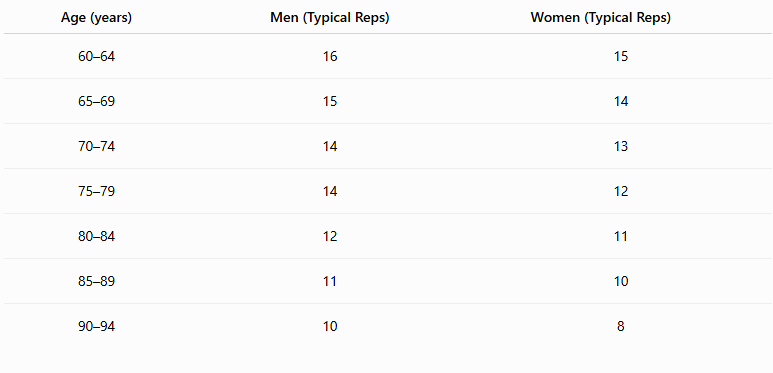
Performance falls steadily from decade to decade and drops more sharply after 80. Men complete one to two more stands than women on average.
Also read: Grip strength predicts how long you'll live better than blood pressure, huge study finds
What a low score means
The US Centers for Disease Control and Prevention has built the chair stand into its STEADI (Stopping Elderly Accidents, Deaths and Injuries) fall-prevention protocol. In the CDC scoring sheet, a score in the bottom quarter for your age and sex is flagged as below average and points to elevated fall risk.
The cutoffs the CDC uses are:
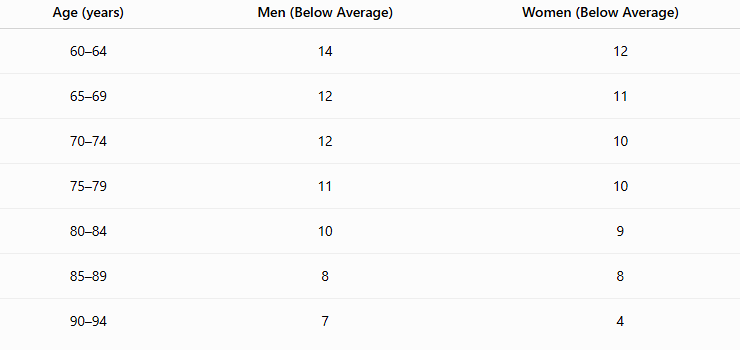
A single low score is not a diagnosis. It is a nudge to bring the number to your primary care doctor or a physical therapist, who can look at balance, medications, vision and home hazards alongside strength.
The strength side is trainable
Lower-body strength is one of the most consistently trainable fitness qualities in older age, even in people already flagged as frail. In a 12-week trial published in 2023 in Innovation in Aging, older adults with mobility disability who did just four minutes a day of body-weight strength work, including chair stands, push-ups, resistance-band rows and stair-stepping, added an average of 4.2 chair stands over the intervention period compared with controls.
Also read: She walked 20,000 steps every day for a month – here's what she learned
The practical takeaway is small doses, done most days. Sit-to-stands from a dining chair, squats holding a countertop for balance, and step-ups on a low stair all target the same muscles the test measures. Adults with heart, joint or balance conditions should clear a new routine with their doctor before starting.
Also read: Just 13 minutes of exercise a day may be enough to lower your risk of early death
This article is made and published by Jesper Bengtson, who may have used AI in the preparation.